
Versalino Uno Technical Specs & Pinout Guide
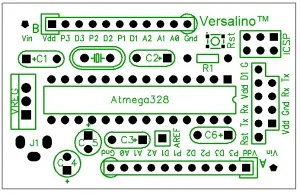
Description:
The Versalino™ is the first of an all new line of Prototype to Production Platforms. The Versalino™ is compatible with all code written for the Arduino Uno/Duemilanove, but has the added benefit of a powerful new pinout and libraries that allow you as a designer to tap into the raw power of your microcontroller.
Rather than give you another Arduino clone, we have taken the familiar micro-controller and developed a platform that allows you to focus on the other elements of your next design. With the Versalino™ BUS system you can rest assured that your hardware design will be compatible with future more powerful versions, and that your hardware will not interfere with other peoples designs.
WARNING: The Versalino™ may make you think twice about giving up on your next project.

Versalino™ Uno by Virtuabotix LLC is licensed under a Creative Commons Attribution-NonCommercial-ShareAlike 3.0 Unported License.
[2026 update: relicensed by the author — hardware now CC BY 4.0, code Apache-2.0; see the GitHub repo.]
Technical Specifications (For standard build):
Processor: Atmega 328 |16 MHz Clock Speed Memory: Flash 32 KB | EEPROM 1 KB |SRAM 2 KB Pins: Digital I/O Pins 14 | Analog I/O Pins 6 PWM (Pulse Width Modulation) Pins 6 Versalino Bus’s: 2 (BUSA, BUSB) Communication: One FTDI compatible program port and 1 BT2S compatible COM port
Package Contents:
• Versalino™ Uno • Pin-out and Quick Reference Guide
Pinouts:
Versalino™ Primary Buses (BUSA/BUSB): Great care was taken in the design of the Versalino™ to ensure that an even cross section of the pin types was available to any device that used them. As such each Bus has 3 of each type of Pin Digital, Analog, and PWM.
Additionally the Versalino™ Bus provides access to both regulated and Supply Voltages for any device that uses them. This feature lends toward dramatic design simplification, and allows most designs that would otherwise need to cover an entire board on another platform to take up only a single port.
The Versalino™ is built using 90 degree female Headers to take advantage of this fact. It is possible to use vertical ports, but loading upgrade boards horizontally makes it possible to support multiple upgrades at once without impacting the height of your design, or interfering with the functionality of attached devices. It is possible to use cable headers, or solder cables/wires directly to allow for even more flexibility of design.
BUSA
| BUSA | Arduino™ Equiv | Function |
|---|---|---|
| Gnd | GND | Ground |
| A0 | A0 | Digital/Analog |
| A1 | A1 | Digital/Analog |
| A2 | A2 | Digital/Analog |
| D1 | 2 | Digital/Interrupt |
| P1 | 3 | Digital/PWM |
| D2 | 4 | Digital |
| P2 | 5 | Digital/PWM |
| D3 | 13 | Digital/SCK |
| P3 | 6 | Digital/PWM |
| Vdd | 5 | Regulated Power |
| reserved | Not attached | |
| Vin | Vin | Supply Voltage |
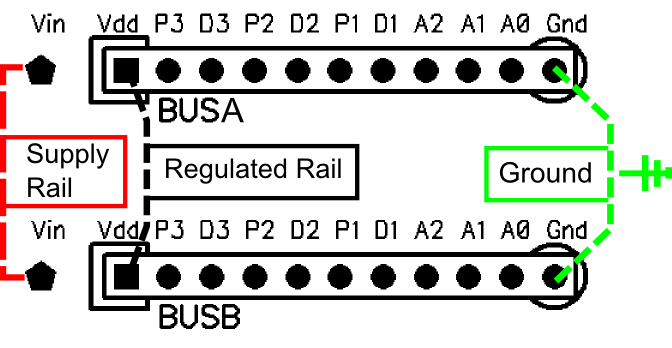
BUSB
| BUSB | Arduino™ Equiv | Function |
|---|---|---|
| Gnd | GND | Ground |
| A0 | A3 | Digital/Analog |
| A1 | A4 | Digital/Analog |
| A2 | A5 | Digital/Analog |
| D1 | 7 | Digital |
| P1 | 9 | Digital/PWM |
| D2 | 8 | Digital |
| P2 | 10 | Digital/PWM |
| D3 | 12 | Digital/MISO |
| P3 | 11 | Digital/PWM/MOSI |
| Vdd | 5 | Regulated Power |
| reserved | Not attached | |
| Vin | Vin | Supply Voltage |
Unleash the power of your Versalino™ Library for the Arduino IDE available for download.
Versalino™ library for the Arduino™ IDE
Versalino™ COM1 Port: The COM1 Port is right next to the PGM port, and provides access to the full regulated power rail and the standard Tx and Rx ports. This port is ideally suited for providing a communication link between master and slave units. It also allows units to easily share a single regulated power bus between multiple devices.
| COM1 | Arduino™ Equiv | Function |
|---|---|---|
| Tx | Tx->1 | Digital/Serial Tx |
| Rx | Rx->0 | Digital/Serial Rx |
| Gnd | GND | Ground |
| Vdd | 5/3.3 Volts[1] | Regulated Power |
Versalino™ PGM Port: The PGM port serves several purposes. The first of which is to provide an easy way to program your chip during development and production. The second function is the ability to easily add a communication link between the Versalino™ and a variety of other Serial devices to include additional Versalino™/Arduino™ platforms. The third function is to simplify the process of managing Firmware Upgrades for complex devices (that use more than one micro-controller).
| PGM | Arduino™ Equiv | Function |
|---|---|---|
| G | GND | Ground |
| D1 | 2 | Digital/Interrupt |
| Vdd | 5V | Regulated Voltage |
| Rx | Rx->0 | Digital/Serial Rx |
| Tx | Tx->1 | Digital/Serial Tx |
| Rst | RESET | Reset pin |
If you want to know even more about the Versalino™ you may want to read this article.
This is our first development platform, and it is manufactured in the US. Every share makes it possible for us to bring you more great electronic designs made right here in the USA.
Unleash the power of your Versalino™ Library for the Arduino IDE available for download.
Versalino™ library for the Arduino™ IDE
Get detailed information from the Versalino™ Datasheet Revision 1S2 dated 26 April 2012 available for download.
Most Recent Versalino™ Datasheet
More Development tools:
Write your own Versalino™ libraries. Versalino™ Library writing template for the Arduino IDE available for download.
Versalino™ Library writing template for the Arduino™ IDE
Make your own Versalino™ Loadboard! Versalino™ Loadboard template Gerber files, and Schematics available.
All the tools you need to design your own Versalino™ load board!
Restored from the josephdattilo.com archive — original publish date preserved. Lightly cleaned up for the modern site; the words are period-correct. The Versalino Uno specs and pinout above were originally published by Virtuabotix LLC under a Creative Commons Attribution-NonCommercial-ShareAlike 3.0 Unported License; that license carries forward with this reproduction.
The hardware is open source
The Versalino Uno’s schematics, PCB layout, and Gerber files are being published as open hardware. Follow along (or fork it) at my GitHub (as the design files are recovered) — schematics, board files, and manufacturing Gerbers for the board documented on this page.
I'm Joseph Dattilo — engineer-founder in Lansing, Michigan, author of the FleetHarbor suite, and founder of Date Palm Media. More about me · More writing · Get in touch